Every form of entertainment that involves money and chance carries a risk of harm for some of the people who engage with it, and online gambling is no exception. What separates a healthy relationship with casino games from a damaging one is rarely luck; it is the presence, or absence, of guardrails. Over the past decade the industry, regulators, and players themselves have built an increasingly sophisticated set of tools designed to keep gambling within the bounds of entertainment. Understanding these guardrails — what they are, how they work, and how to use them — is arguably more important than understanding any game.
Why responsible gaming is a shared responsibility
Responsible gaming is often framed as either a matter of individual willpower or of operator obligation, but it is genuinely both, and the framing matters. On the individual side, the player brings self-awareness, honesty about their own behaviour, and the discipline to set and respect limits. On the operator side, a legitimate casino provides the tools, the information, and the interventions that make responsible play possible in practice, rather than leaving players to fend for themselves.
Neither alone is sufficient. A determined individual can still be undermined by an environment engineered purely for engagement; a well-designed set of tools is useless to someone who refuses to use them. The healthiest online gambling ecosystem is one where operators treat player wellbeing as a genuine priority — not merely a regulatory box to tick — and players treat the available safeguards as normal, sensible parts of the experience rather than admissions of a problem. This shared model is the foundation on which every specific tool rests.
Limits: the everyday guardrail
The most widely used and most quietly effective tools are limits, and they work precisely because they are set in advance, in a calm moment, rather than in the heat of play. Deposit limits cap how much a player can pay into an account over a day, week, or month, creating a firm ceiling on exposure regardless of how a session unfolds. Loss limits and wager limits perform similar functions, restricting how much can be lost or staked within a period. Session and time limits address the other dimension of harm — not money but hours — by reminding a player how long they have been playing or ending a session automatically.
The power of these tools lies in their timing. A limit chosen before a session, when judgement is unclouded, protects a player from decisions made later, when excitement or frustration might push them past their intended boundaries. Setting a deposit limit is a small act with a large protective effect, because it removes the need to rely on in-the-moment self-control, which is exactly what tends to weaken during play. Reputable operators make these limits easy to find and set, and using them proactively is the single most practical habit in responsible gambling.
Time-outs and self-exclusion for stronger boundaries
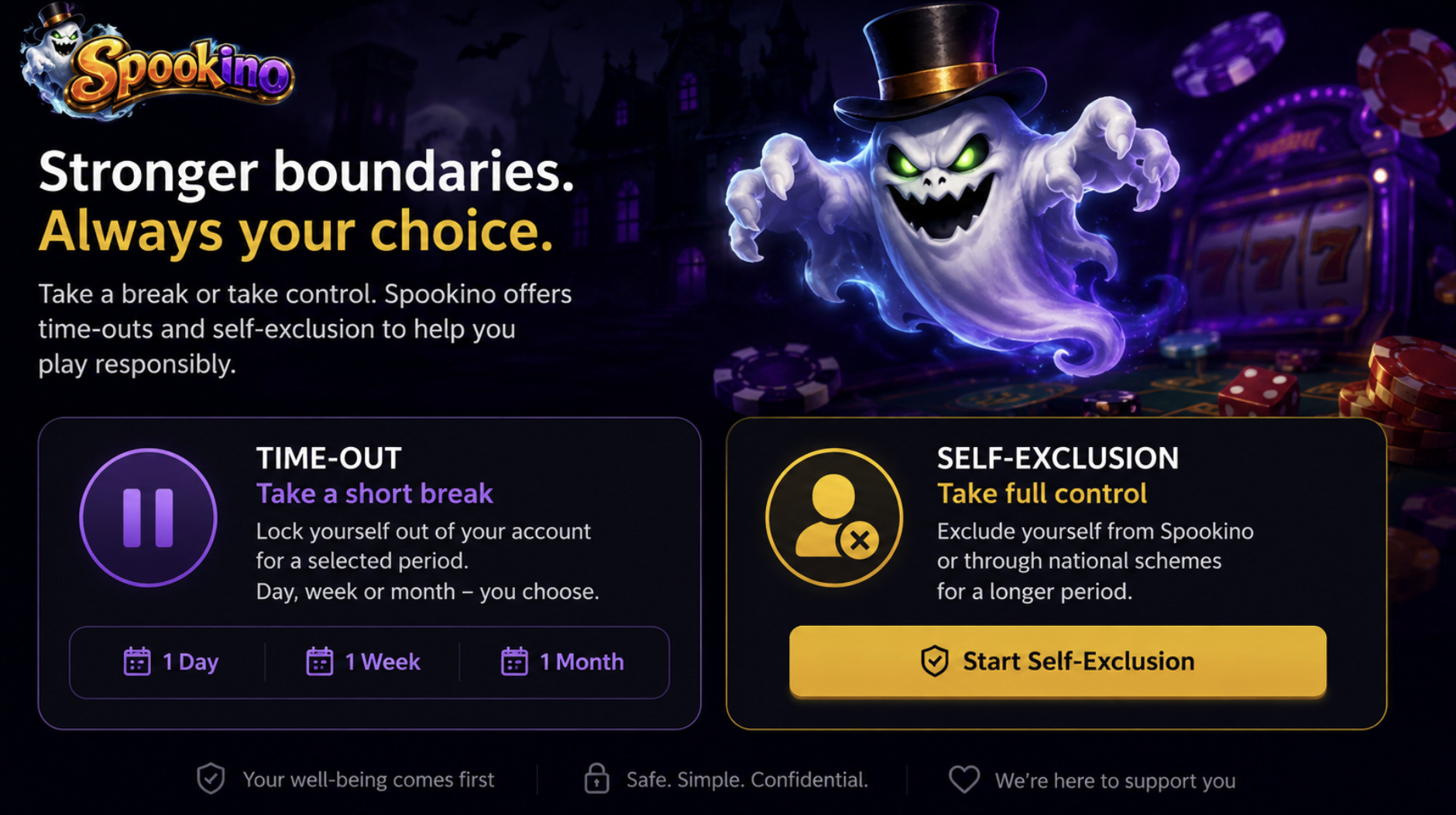
Sometimes limits are not enough, and a player recognises they need a firmer break. Two escalating tools exist for this. A time-out, or cool-off, lets a player lock themselves out of an account for a short defined period — a day, a week, a month — during which they cannot play. It is a pause button, useful for stepping back and regaining perspective without making a permanent decision. For many people, a well-timed cool-off is enough to reset a habit that was drifting in the wrong direction.
Self-exclusion is the more serious step, allowing a player to bar themselves from an operator, or through national schemes from many operators at once, for an extended period that cannot be casually reversed. It exists for those who recognise they need to stop and want the decision protected from their own future impulses. The existence of these tools reflects an important principle: a player's decision to disengage should be honoured and made easy, not obstructed. An operator such as Spookino that provides accessible time-out and self-exclusion options alongside its games is treating these safeguards as core features rather than fine print, which is exactly how a responsible platform should behave.

Recognising the warning signs
Guardrails work best when a player can recognise, honestly, when they are needed. Certain patterns tend to signal that gambling is drifting from entertainment toward harm. Chasing losses — continuing to play in an attempt to win back money already lost — is among the most dangerous, because it converts a contained loss into a spiralling one. Spending more time or money than intended, repeatedly and despite meaning to stop, is another clear signal. So is gambling to escape stress or low mood rather than for enjoyment, and hiding the extent of one's play from others.
Naming these signs matters because the difficulty of gambling harm is that it develops quietly, often without any single dramatic moment. A person can drift from recreation into difficulty while telling themselves a reassuring story about being in control. Learning the warning signs, and being willing to apply them to one's own behaviour without shame, is what allows the guardrails to be used before harm becomes serious. Problem gambling is a recognised behavioural issue, not a moral failing, and treating early signs as information to act on rather than weakness to hide is the healthiest possible stance.
The role of design and information
Beyond the explicit tools, responsible gaming is shaped by the less visible choices operators make in how they design and inform. Reality checks that pause play to display how long a session has lasted, clear presentation of the odds and house edge, transparent bonus terms that do not pressure players into overextending, and interfaces that do not manufacture false urgency all contribute to an environment where players can make considered decisions. Conversely, design tuned purely to maximise engagement pulls in the opposite direction.
The information dimension is equally important. Players who understand that games carry a built-in house edge, that outcomes are independent and cannot be predicted, and that no system overcomes the mathematics are far better protected than those operating on misconceptions. A responsible operator does not merely provide tools; it fosters an informed player, because accurate understanding is itself a form of protection. This is why education — of exactly the kind that explains RTP, volatility, and the true nature of the games — is inseparable from responsible gambling rather than a separate topic.
When more help is needed
Tools and self-awareness cover a great deal, but some situations call for support beyond what an operator can provide, and it is important to say so directly. When gambling has become a source of genuine distress — financial, emotional, or relational — professional help exists and works. Dedicated helplines, counselling services, and support organisations offer free, confidential assistance, and reaching out to them is a sign of strength rather than failure. Reputable operators signpost these services prominently, precisely because directing a struggling player toward real help is part of responsible operation.
For anyone who recognises the warning signs in themselves or someone close to them, the most important message is that help is available and that acting early makes recovery far easier. Gambling is intended as entertainment for adults, enjoyed within limits, and when it stops being that, stepping back is always the right choice. This is a sensitive subject, and no article is a substitute for personalised support; if any of this resonates personally, contacting a local gambling-support service is a good and courageous next step.
Conclusion
Responsible gaming is the framework that keeps online gambling in its proper place as entertainment rather than harm, and it rests on a partnership between informed players and operators who take wellbeing seriously. Its guardrails are practical and effective: limits set in advance, time-outs and self-exclusion for firmer breaks, honest recognition of warning signs, thoughtful design and clear information, and accessible routes to professional help when needed. None of these diminishes the enjoyment of the games; they are what make sustained enjoyment possible. The players who fare best, and the operators worth trusting, are the ones who treat these safeguards not as an afterthought but as a central, normal part of what online gambling should be.